Drive business value from advanced technology
Process mining, automation and AI all offer significant potential for businesses to improve performance. However, many organisations struggle to realise that value when these capabilities are introduced as separate initiatives.
Infor Velocity Suite brings them together in an all-inclusive, preconfigured package designed to help organisations running Infor CloudSuite to take an end-to-end approach to analysing processes, identifying inefficiencies and taking targeted action to improve performance.
In this Q&A, Mads Stenbye, Solution Director of M3 and Victoria Ulrikz, Senior Solution Consultant of M3 at Columbus, explain what Infor Velocity Suite is, how process mining works in practice, and the benefits of using a bundled, predefined solution. They also share practical insights from a real delivery experience, explaining how one business utilised process mining within Velocity Suite to analyse its processes and turn its findings into meaningful, measurable improvements.
What is Infor Velocity Suite and what are the problems it’s designed to solve for businesses?
Mads: Infor Velocity Suite is a bundle of technologies that Infor has put together in a packaged offering for customers. What’s unique about it is that Infor isn’t just delivering the technology itself, but making sure it’s ready for use from the start.
The solution is predefined for specific business use cases and challenges. We see that many large ERP and IT investments don’t realise the value they were meant to deliver. Recent research from McKinsey found that only around 20% of companies capture more than half of the expected benefits from ERP systems. Infor Velocity Suite is designed to address that gap.
It focuses on capturing business value from IT investments and initiatives and driving measurable outcomes, such as better efficiency and improved processes. By bundling these technologies together, Infor Velocity Suite makes it possible to analyse how a business is operating, identify where there’s potential for improvement, and then act on it in a structured way.
What are the core components of Infor Velocity Suite, and how do process mining, automation and AI work together?
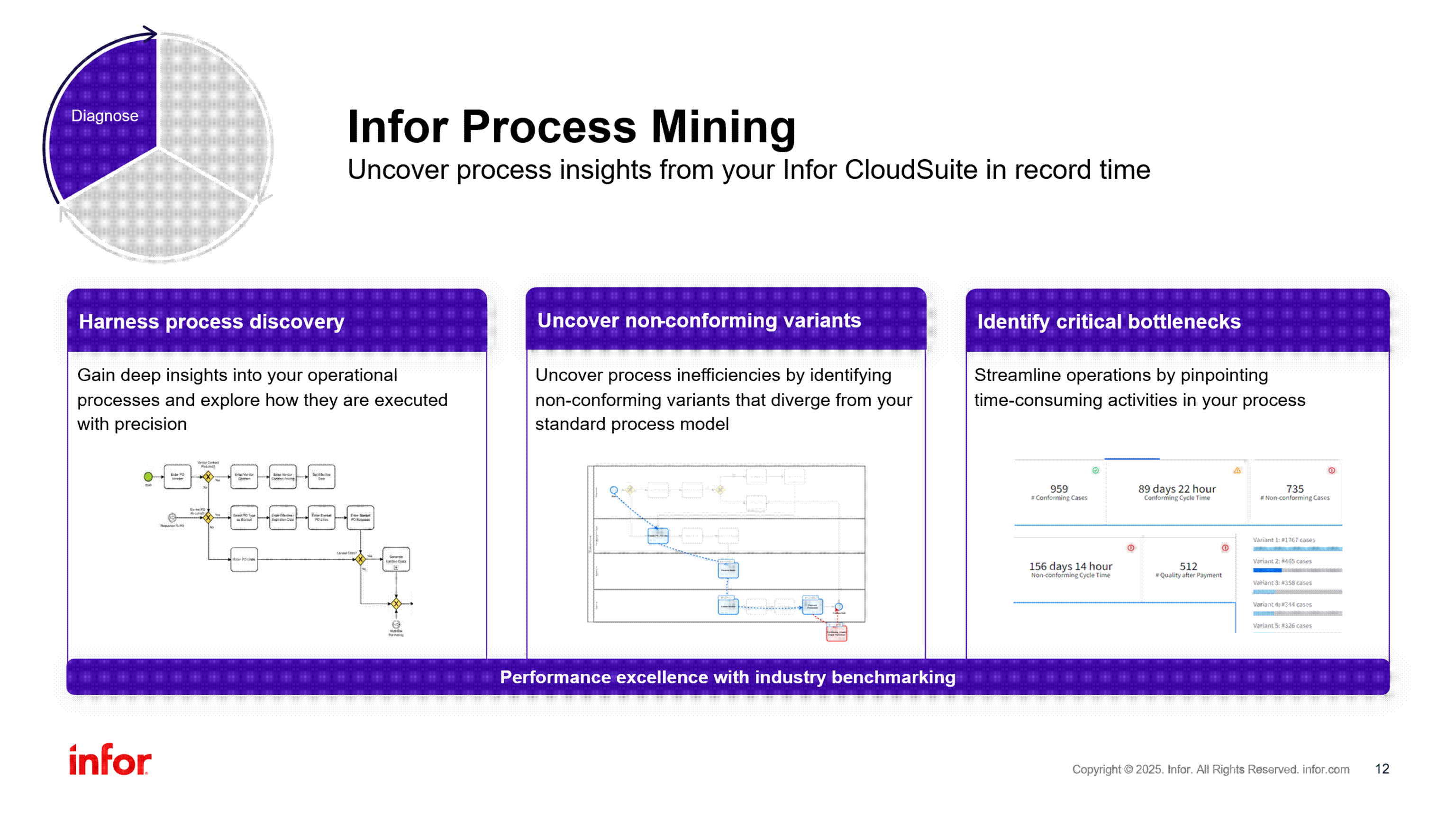
Mads: It starts with analysing the business through process mining, which allows us to see how processes are executed and identify where there are bottlenecks, rework, inefficiencies, or deviations from standard processes.
Once those areas are identified, automation can be introduced. Infor has included tools in the Velocity Suite that focus on robotic process automation and document processing. These are used to automate repetitive and manual tasks, such as invoice handling or order entry, where there’s clear value in taking work away from employees and letting technology handle it instead.
AI then supports areas where processes can’t be fully automated. Depending on the use case, this can involve machine learning or generative AI to help people become more productive. For example, by summarising information, suggesting next best actions, or supporting decision-making inside the ERP system.
Overall, the idea is to analyse what’s happening through process mining, automate what makes sense to be automated, and support people in the areas where human involvement is still needed.
In simple terms, what is process mining, and why is it an effective starting point for improvement?
Mads: Process mining is about analysing how business processes are executed based on real data from the system. Every transaction and event in the ERP system has a timestamp, which allows process mining to reconstruct what happens in a process, step by step.
What makes process mining effective is that it’s based on facts rather than opinions. Traditionally, if a business wants to understand how a process works, it often relies on manual time studies, interviews with employees across the organisation, or reports that might not show the full picture. That approach can be time-consuming and sometimes political, because people don’t always want to highlight where processes aren’t working as well as they should be.
With process mining, it becomes clear where processes deviate from the standard, where rework happens, where delays happen, or where defined ways of working aren’t being followed. It provides an objective view of how processes run, which makes it a strong starting point for identifying possible improvement areas.
What makes Infor Velocity Suite different from other solutions on the market?
Mads: One of the key differences is how pre-configured the solution is. Infor Velocity Suite works largely out of the box, with Infor having already completed a significant amount of the work required to map business processes into the technology.
Process mining as a capability has been around in the industry for several years, but adoption has traditionally been low because it’s expensive and complex to map process data into those tools. Infor has already embedded that mapping into its software suite, which means customers don’t have to build the solution from scratch.
The same applies to automation and AI use cases. There’s already a catalogue of predefined, high-value use cases included. This gives businesses a strong starting point and allows them to achieve value faster than if they had to identify, build and implement each use case independently.
Who is Infor Velocity Suite for, and what needs to be in place for a business to use it successfully?
Mads: Infor Velocity Suite is designed for customers who are already on Infor CloudSuite, for example M3 Cloud. That’s because the pre-built integrations and mappings are based on Infor’s standard, industry-specific ERP solutions.
If a business is running Infor M3 on-premise or a different ERP system, it doesn’t get the benefit of that pre-configured setup. In that case, the organisation would need to implement and integrate the technologies from scratch.
It’s also worth highlighting that Velocity Suite is an additional solution, meaning customers need to invest in it separately. For CloudSuite customers however, it becomes an effective way to build on the standard system and start driving continuous improvement and value from their ERP investment.
Can businesses get value from Infor Velocity at different stages of their CloudSuite journey?
Mads: Yes they can, depending on what data is available and which parts of the suite they choose to use. Process mining, for example, relies on historical process data, which means it typically becomes most valuable once a business has been live on CloudSuite for a period of time and has enough data to analyse. Not all businesses will have this immediately after moving to CloudSuite, but once sufficient data is available, process mining can be used on an ongoing basis to regularly review process performance.
However, that doesn’t mean Infor Velocity Suite can’t deliver value early on. If process mining isn’t possible to begin with, organisations can start by using predefined automation use cases during implementation such as accounts payable automation, where there’s often a clear need from day one.
This flexibility means businesses don’t need to adopt Infor Velocity Suite all at once. They can start with the capabilities that make the most sense for their situation and then expand their use of the solution over time as their processes and CloudSuite maturity develop.
You recently worked alongside Infor on a Velocity Suite project for a customer. Can you tell us about the context and objectives?
Victoria: It was a manufacturing company where Infor Velocity Suite was used to analyse their production processes. From the beginning, they were clear that processes weren’t performing as they should, but they were unable to pinpoint exactly where the issues were occurring.
The business didn’t have the volume or the analytical tools needed to process that data in a way that would provide clear insight into what was happening across their processes. What prompted them to begin this work was that they weren’t meeting their budget, while at the same time experiencing an increase in production volumes and customer orders.
As a result, they were producing more without having the visibility needed to understand why performance wasn’t improving or why costs were increasing. This was part of a larger manufacturing group, and the analysis focused on one plant that was underperforming compared to the rest of the organisation.
How did you apply process mining for the business and what insights came out of that analysis?
Victoria: We started by defining the scope of the analysis, including which time period was relevant and what they wanted to understand from the data. The data was then loaded from the data lake into the process mining tool, with a focus on the pre-configured production-to-inventory process.
All activity in M3 has a timestamp, which means that once the data is loaded, events are automatically mapped to that process. This makes it possible to analyse when manufacturing orders are created, closed or deleted, and to identify the most common process variants as well as non-conforming variants.
Through this analysis, several interesting patterns emerged. For example, we could see the exact number of manufacturing orders that were being deleted, which immediately raised questions about why this was happening and which products were affected. We also identified manufacturing orders where material was scrapped, which has a significant impact on cost, time and overall efficiency.
Because the process mining tools allows teams to drill down into the data, it becomes possible to explore specific areas in more detail and start building an understanding of the potential cost and impact of these issues over time.
How did the business respond to the findings from the process mining analysis?
Victoria: The response was very positive. The business found it extremely valuable to be able to identify and pinpoint specific issues based on data rather than assumptions. Having clear findings made it a lot easier to discuss the situation internally and decide what to focus on next.
One important aspect was how IT could bring those insights to the business in a clear and structured way. Using the preconfigured dashboards in the process mining tool, it was possible to show the findings without any additional configuration, which made the data easy to understand and share across the organisation.
This helped create alignment around what the real issues were and which areas needed attention. Being able to say, “these are the specific areas we’ve identified in the data,” made it easier for decision-makers to understand the situation and approve next steps.
If the business hadn’t used Infor Velocity Suite, what would the alternative analysis have looked like?
Victoria: Without Infor Velocity Suite, the business would have had to rely a lot more on employees’ opinions about what they believed the issues were, rather than on data. Another option would have been to compile data using tools such as Excel or traditional BI reports, but it’s very difficult to map processes in that way. This is especially the case when exact timestamps are needed for all the events and for understanding the relationships between areas such as purchase orders, production orders, and inventory movements.
Mads: It’s also a very time-consuming and error-prone way of working. Traditionally, operational analysis often involves employees standing on production lines with stopwatches, conducting interviews, and manually drilling into data. Without the system connections in place, it becomes a lot harder to see the full picture of how processes are being executed end to end.
Once the data highlights issues or misalignments, how should businesses think about turning those insights into action?
Mads: One important point is that not every issue uncovered needs to be solved by automation or AI. In several cases, the foundation needs to be addressed first. That can mean changing how processes are executed, adjusting how the ERP system is configured, or making better use of the standard functionality that already exists.
In this case, process mining helped highlight that the system was being used in one way, while the physical processes in the plant required it to be set up differently. In some areas, the business wasn’t fully utilising the capabilities of the standard ERP system, which affected both reporting and decision-making.
Uncovering these kinds of misalignments shouldn’t be seen as a negative. It represents an opportunity to improve how people work, how the system supports them, and where automation or AI can later add value once the basics are in place.
Victoria: I agree with Mads. Some of the issues identified are more closely related to ways of working, planning knowledge, or collaboration across functions. Process mining provides the facts, but the next step is deciding what to prioritise and involving the right people to make the necessary changes.
How can Columbus support organisations with Infor Velocity Suite?
Mads: Infor Velocity Suite gives businesses a data-driven way to understand how their processes are operating over time. It allows them to identify inefficiencies, areas of rework and deviations from standard ways of working, and to use those insights to support ongoing improvement rather than relying on assumptions.
To maximise the value of that insight, it’s important to work with an Infor-recognised partner that understands how to apply Velocity Suite in practice. That includes knowing how to interpret the insights it provides and how to translate those insights into meaningful, achievable improvements in the business. Completing Infor’s credentialing assessment for Velocity Suite delivery is an important achievement for us, as it confirms our capability to deliver and support this solution effectively in real customer environments. For our customers, that provides confidence that Velocity Suite can be implemented and utilised in a structured, value-focused way.
This approach aligns closely with our managed services model. Through managed services, we support customers on an ongoing basis, using tools like Velocity Suite as part of regular reviews and governance. That allows us to track progress over time, identify new improvement opportunities, and help customers continuously evolve how they use their platform. In practice, this gives organisations a structured way to embed continuous improvement into day-to-day operations, with our team supporting them long term.
For more information on how we can help your business, feel free to contact a member of our team below.


