GEO vs SEO: Moving from keywords to conversations
Until recently, traditional search followed a familiar pattern: a user searched a phrase, scanned a list of results, clicked a link and navigated through a website. For businesses, success depended on ranking high enough to earn that click.
Today, that journey increasingly looks different. A customer might ask: What are the best supportive tennis trainers under £150 for someone who plays three times a week?
Rather than returning a list of links, an AI assistant provides a direct answer with a shortlist of recommended products and why they fit the requirement. Customers may never browse multiple websites or even click at all. This is the emergence of the AI-driven customer journey and ‘zero-click’ experiences, where the answer itself becomes the destination. The customer experience moves beyond search and into conversation.
For organisations, this creates a fundamental shift in thinking. Visibility is no longer solely about ranking for clicks. It’s about ensuring that machines and AI agents can correctly understand, compare and recommend your products or services.
What is GEO?
Generative engine optimisation, or GEO, is an emerging strategy focused on optimising content, product information and digital assets so that AI systems can accurately interpret, trust and recommend them.
This doesn’t mean that your existing search engine optimisation work is no longer valuable – GEO sits alongside SEO to make sure your content gets surfaced. SEO and GEO are complementary, not competing. SEO remains critical for discoverability on search engines like Google and Bing, while GEO builds on those foundations by addressing how large language models (LLMs), AI assistants and autonomous agents understand and use content.
You might also hear the term answer engine optimisation (AEO), sometimes referred to as AI search optimisation. This approach focuses specifically on helping content appear within direct answers generated by AI-powered search and answer engines. If SEO helps a search engine find your content, AEO helps an answer engine confidently use it when responding to a question. GEO is the broader strategic category covering answer engines, AI assistants, shopping agents, recommendation systems and future AI-driven discovery channels.
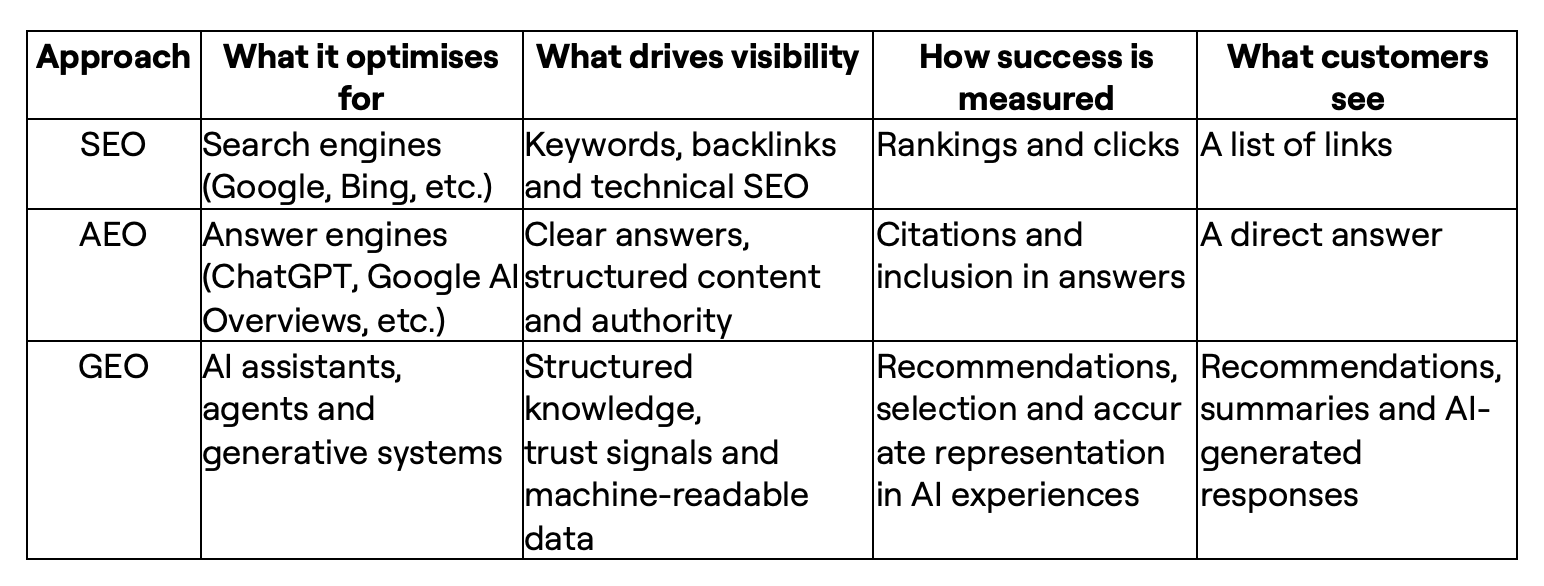
A useful way to think about the SEO vs GEO difference, and where AEO fits in, is:
|
Approach |
SEO |
AEO |
GEO |
|
What it optimises for |
Search engines |
Answer engines |
AI assistants, |
|
What drives visibility |
Keywords, backlinks |
Clear answers, structured content |
Structured knowledge, trust signals and machine-readable data |
|
How success is measured |
Rankings and clicks |
Citations and inclusion in answers |
Recommendations, selection and accurate representation in AI experiences |
|
What customers see
|
A list of links |
A direct answer |
Recommendations, summaries and AI-generated responses |
Taken together, leading businesses are already building a combined SEO and GEO strategy.
The strategic question therefore changes. Instead of asking: Does my page rank? Organisations increasingly need to ask: Is my product or service included in AI-generated answers, and is it described correctly?
Why GEO matters for AI visibility
The way customers discover brands, products and services is changing. Increasingly, consumers are turning to AI assistants and answer engines to help them research options, compare providers and make decisions before visiting a website. A recent Adobe survey found that 77% of people who use ChatGPT use it as a search engine, with 36% discovering new products or brands through the AI assistant.
AI is becoming a new layer between organisations and their customers. At the National Retail Federation (NRF) 2026, one of the dominant industry themes was the rise of agentic commerce and AI-powered customer experiences. The boundaries between digital and physical interactions are blurring, while AI agents in e-commerce are evolving from search tools into ‘co-shoppers’ that actively participate in the customer journey.
The commercial impact is already becoming visible, with Shopify reporting a 14x increase in orders originating from agentic applications since the beginning of 2025. As AI agents become responsible for more discovery, being absent from AI-generated responses is fast becoming the equivalent of the ‘page-two obscurity’ – where web traffic is lost to the first page of search results.
Digital experiences must serve humans and machines
The challenge for organisations now is that websites need to serve both human visitors and AI systems. Customers still expect intuitive and engaging experiences, while AI assistants, search crawlers and LLMs rely on structured, machine-readable information to understand and recommend products or services.
As conversational tools like ChatGPT, Claude and Gemini become part of everyday search and research, organisations need to think beyond user experience alone. Their websites must also provide the knowledge that AI can interpret and trust. For GEO to be effective, digital experiences must be understandable to both people and machines. In an AI-driven customer journey, visibility depends not only on what people can see, but on what machines can understand.
Your GEO checklist for AI visibility
How prepared is your organisation for AI-driven discovery? A useful starting point is a simple self-audit. The more of these questions you can answer ‘yes’ to, the stronger your GEO foundations are likely to be.
1. Data foundations
Do you have a central source of truth?
Is your product information complete, consistent and governed?
Can products be compared using standardised attributes?
Do you maintain rich product specifications, dimensions and technical data?
2. Machine readability
Is your data accessible beyond the visual webpage?
Do you use structured data and schema markup?
Are product attributes clearly defined?
Can AI systems access information about offers, availability, FAQs and reviews?
3. Content and authority
Do you have authentic customer reviews?
Is pricing transparent and current?
Do you provide detailed product descriptions and use cases?
Are supporting resources available, such as guides, documentation and comparison content?
4. Governance and trust
Are product claims accurate and verifiable?
Is certification information available?
Are sustainability, compliance and safety claims documented?
Is content regularly reviewed and maintained?
5. Knowledge architecture
Perhaps the most important question is: Can your products or services be understood, trusted and recommended wherever customers are searching for them?
AI is exposing a new challenge that sits beneath the digital experience: knowledge architecture. While experience architecture remains critical for human experiences – knowledge architecture is what makes organisational information accessible everywhere: for humans, search engines, AI systems and digital experiences.
This requires organisations to think beyond individual webpages and consider how product information, customer context, documentation, assets and supporting content connect as part of a wider knowledge architecture.
Key knowledge elements often include:
- Product type
- Industry classification
- Technical attributes
- Certifications
- Compatible products
- Related documentation
- Customer use cases
The stronger and more connected this knowledge layer becomes, the easier it is for AI systems to understand and recommend your products or services.
Where GEO meets PIM
Many organisations understand the opportunity presented by AI, but far fewer are prepared for the shift.
This is where product information management (PIM) becomes essential. A PIM platform acts as the engine room of GEO by creating a trusted, governed source of product knowledge that can be distributed consistently across channels. If product information is incomplete, inconsistent or fragmented, AI systems struggle to accurately interpret and compare offerings.
PIM doesn’t guarantee inclusion in AI-generated answers. However, without a strong product data foundation, achieving meaningful visibility within AI systems becomes much more challenging.
The reason is simple: AI can’t recommend what it doesn’t understand.
Leading vendors are already evolving their platforms to support this shift.
These capabilities point towards a broader trend: GEO is not a marketing strategy, but rather a data capability.
To see how a modern PIM platform puts this foundation in place, explore Columbus’ PIM solutions.
How to get started with GEO
The good news is that most organisations don’t need to rebuild their product data and content from scratch. A practical starting point is to focus on one product category and assess it through a GEO lens.
Start by:
- Auditing a category against the GEO checklist
- Fixing data quality and governance issues first
- Expanding structured data, schema markup and product feeds
- Identifying gaps in product attributes and supporting content
- Testing how today’s AI assistants describe and recommend your products or services
This final step is often the most revealing. Are your products included in AI-generated answers? Are they described accurately? Are key differentiators being recognised?
If not, the issue is often not visibility – but knowledge quality.
Customers experience a webpage, but AI systems consume knowledge. That knowledge rarely exists in one place; it often spans PIM platforms, CMSs, DAM systems, CRM platforms and search technologies. The website is simply the interface that brings it together.
Help AI understand your business
As AI becomes an increasingly influential participant in commerce, organisations must think beyond rankings and traffic alone. Those that succeed will be the organisations whose product knowledge is most complete, trustworthy and machine-readable.
In the age of AI-assisted discovery, being understood is becoming just as important as being discovered.
