A new reality for poultry processors
Poultry processors operate in one of the most efficient and complex supply chains in the food industry. Demand remains strong, operations are highly optimised, and the industry continues to scale. Yet behind this efficiency lies a structural challenge that’s often underestimated. Poultry processing isn’t just a manufacturing operation. It requires the continuous coordination of biological and industrial systems.
Live animals are naturally subject to variation, but they must be aligned with tightly scheduled processing plants, strict customer requirements, and increasing expectations around welfare, traceability, sustainability, and transparency. At the same time, external pressures are intensifying. Retailers demand deeper insight into origin and production. Regulators expect faster and more detailed compliance. Consumers want to understand not just what they buy, but where it comes from and how it was produced.
In this environment, the traditional combination of ERP systems, siloed planning tools, and spreadsheet-driven processes is no longer sufficient. A more integrated approach is required – one that reflects the realities of the industry and enables better decisions across the entire value chain.
The structural challenge: where biology meets industry
The complexity of poultry processing starts with how the value chain is structured. Most processors control key stages such as breeding, hatcheries, feed production, slaughter, and distribution. However, the grow-out phase is typically handled by contract farmers, introducing a level of variability that cannot be fully controlled.
Growth rates differ. Mortality fluctuates. Feed conversion varies. Environmental conditions impact outcomes. Even under optimal conditions, variability remains a constant.
At the same time, downstream operations demand precision. Slaughter and processing plants operate on tight schedules. Processing lines must be optimised for yield and efficiency. Customers expect specific product attributes, volumes, and delivery windows. Shelf life constraints limit flexibility.
This creates a fundamental tension: the most variable part of the supply chain sits between its most tightly controlled stages. Planning in this environment isn’t about finding a perfect plan. It’s about continuously adjusting to reality – and doing so with better information, tools, and coordination.
Why traditional ERP and planning approaches fall short
ERP systems remain critical for managing transactions, inventory, financials, and traceability. However, they’re designed to manage what’s already happened – not to navigate uncertainty. Planning in poultry requires more. Producers need to anticipate variability, evaluate trade-offs, and continuously rebalance decisions across the value chain.
Traditional planning approaches, built on fixed assumptions about lead times, yields, and supply, struggle to capture this complexity. As a result, many organisations rely on spreadsheets to bridge the gap – creating a fragmented landscape where data is inconsistent, processes are manual, and decisions are reactive.
The result is a persistent disconnect between plan and reality. What’s needed isn’t a replacement of ERP, but an extension that combines specialist poultry processing software with advanced planning, real-time execution, and end-to-end visibility.
Towards a unified operating model
Leading poultry processors are moving towards a more unified operating model where specialised meat processing ERP systems, planning, and execution are tightly connected.
Infor CloudSuite Food & Beverage ERP plays a central role in this model. It provides the transactional backbone of the business, supporting core processes such as procurement, sales, finance, fixed assets, and manufacturing.
At the same time, Infor CloudSuite Food & Beverage ERP includes capabilities that are critical for poultry operations but typically not available natively within other ERP suites. These include plant maintenance, warehouse management, and quality management with integrated LIMS (laboratory information management system) capabilities. Combined with strong master data management across items, customers, and suppliers, this creates a consistent and reliable foundation for operations.
On top of this foundation, advanced planning solutions enable organisations to move from static plans to dynamic decision-making. Instead of relying on a single forecast, planners can evaluate scenarios, balance supply and demand across the value chain, and continuously adjust based on real-world developments.
Execution systems complete the picture by capturing what happens on the processing line, in the warehouse, and across the network, then feeding that information back into ERP and planning. When these elements are connected, organisations can move from reactive to proactive. Decisions are based on a shared understanding of reality, and the ability to respond improves significantly.
Designing the system landscape
Building this unified model requires a system landscape that’s both structured and flexible. In practice, this means combining a strong ERP backbone with best-of-breed solutions in areas where deeper specialisation is needed.
At the centre sits Infor CloudSuite Food & Beverage, acting as the system of record. Around it, integrated systems support planning, execution, traceability, and interaction with upstream and downstream partners.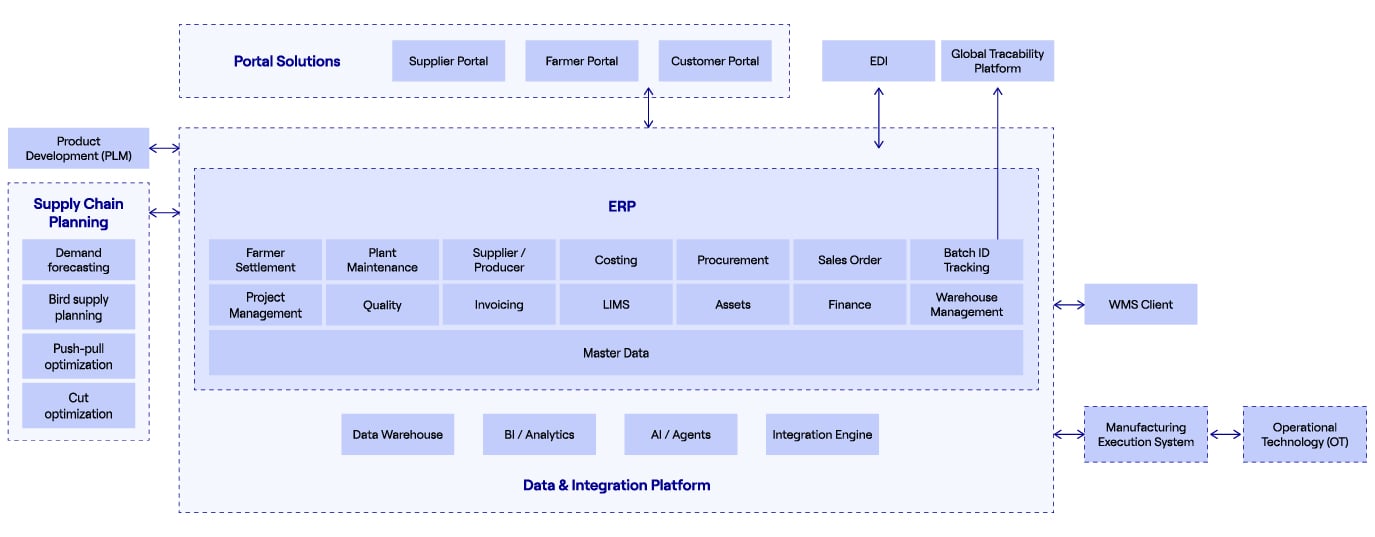
Figure: Example system landscape for a modern poultry processor
A typical architecture for a modern poultry processor includes a specialist meat processing ERP as the backbone, supported by execution systems such as MES (manufacturing execution system), warehouse management, multi-stage planning and platforms that extend traceability beyond the organisation.
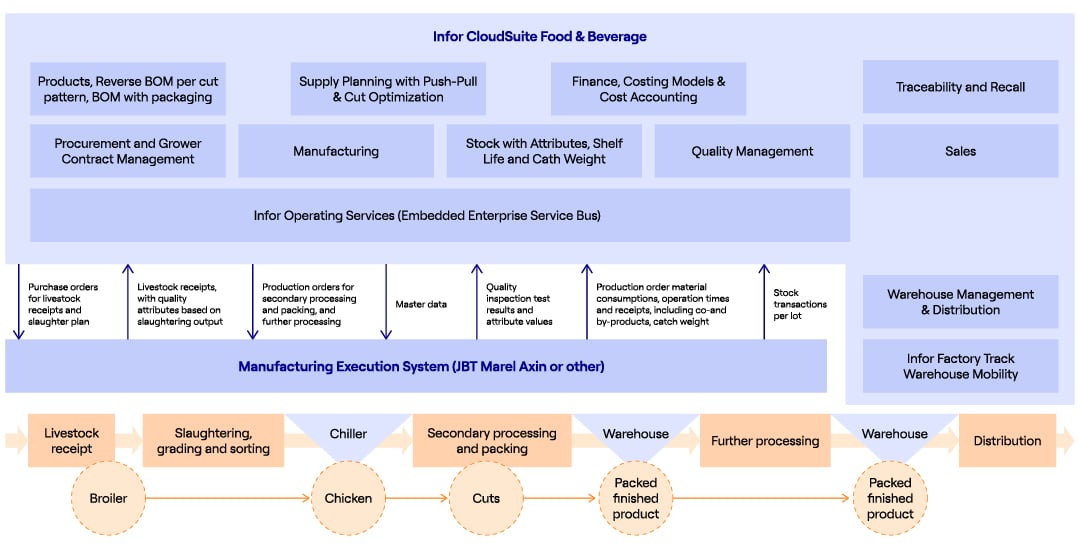
Infor CloudSuite Food & Beverage ERP consolidates core business processes and includes capabilities such as project management, plant maintenance, quality management, and warehouse operations. Managing these processes within the ERP reduces complexity and ensures that critical operational data is managed consistently.
Planning solutions such as Optimity add a layer of intelligence on top of this foundation, enabling scenario-based planning for flock placement and continuous rebalancing across the value chain. The manufacturing execution system ensures that real-time data from processing and logistics is captured and fed back into the system through close integrations with operational technology on the production lines, such as JBT Marel AXIN.
Upstream, farmer portals enable structured collaboration with contract growers, improving visibility into flock development, feed consumption, and mortality. Downstream, EDI integrations, B2B portals, and AI-driven order handling streamline customer interaction and reduce manual processes.
Traceability spans the entire landscape. Infor’s Graphical Lot Tracker provides deep, operational traceability within the organisation, while platforms such as Kezzler extend this capability externally – enabling retailers and consumers to access product-level information about origin, production, and sustainability.
A unified data and integration layer built on Infor Industry Cloud Platform connects these systems and enables reporting and analytics. Data can be consolidated into a shared platform and accessed through tools such as Birst or Power BI, providing insight across operations, finance, and supply chain performance.
The result isn’t a collection of systems, but a connected landscape where data flows seamlessly, decisions are aligned, and the organisation operates as one.
Extending traceability as a competitive advantage
Traceability has long been a requirement in the food industry. Today, it’s becoming a differentiator. Retailers are increasingly positioning transparency as part of their value proposition. They expect suppliers to provide verifiable information about origin, production methods, animal welfare, and sustainability.
Meeting these expectations requires more than internal traceability. It requires the ability to share data externally in a structured and trusted way. By combining ERP-based traceability with extended platforms such as Kezzler, poultry processors can meet these demands – and go beyond compliance. They can strengthen relationships with key customers, support premium product positioning, and build trust with consumers.
In this context, traceability becomes not just a requirement, but an opportunity.
From technology to transformation
While technology is a critical enabler, the real impact comes from how it’s used. Moving to a unified operating model requires changes in processes, data governance, and ways of working. Planning must become more integrated. Data must be consistent across systems. Decisions must be based on shared information rather than local optimisation.
This is where experience matters. Infor provides the industry-specific platform, while best-of-breed vendors add depth in specialist areas. At Columbus, we bring these elements together by designing the architecture, implementing the solutions, and helping to embed the transformation across the business.
The goal isn’t simply to deploy new systems, but to enable better outcomes – more accurate planning , reduced waste, stronger compliance, and improved customer service.
Future of the poultry industry
While the poultry industry has always been data-driven, connected, and transparent, expectations in each of these areas continue to increase, driven by consumer demand, increasing regulation and the need to improve yield.
Artificial intelligence is beginning to play a larger role in forecasting, optimisation, and decision support. IoT technologies are improving visibility into production and farming conditions, while the data captured will increasingly be shared directly with end consumers. At the same time, expectations around sustainability and animal welfare continue to rise. The organisations that succeed will be those that can connect their systems, processes, and data – then use that foundation to continuously improve.
Strengthen your poultry operations
Poultry processing will always involve uncertainty. That’s the nature of the industry. But uncertainty doesn’t have to lead to inefficiency. By placing ERP at the core, extending it with planning, execution, and traceability capabilities, and enabling insight through a unified data platform, poultry processors can create operations that are both resilient and responsive.
Infor CloudSuite Food & Beverage provides the backbone. Best-of-breed solutions extend the capabilities. We bring these elements together to ensure the transformation delivers in practice for your business. This isn’t just about systems. It’s about enabling better decisions – every day. For more information on how we can support your business, reach out to a member of our team using the contact card below.
